

Hello!
October is here. For some of you that means interviews and applications right now, and for others it means starting to think about next year's applications and how you're going to prepare for them.
There is so much advice out there, and it's easy to feel like you need to be doing everything. More questions. More notes. More practice. More advice (at times, contradictory). Life is busy enough as it is, and that pile can leave some people overwhelmed and doing the opposite.
So in this issue I want to help you pause and work out what you actually need to do. One big idea for your examples, a practice question, a hot tip on patient safety, and some news for 2027.
Q4 • OCTOBER 2026
You do not need a different example for every interview question
One of the things that can make interview preparation feel overwhelming is the number of questions you might be asked.
You start thinking:
“What if they ask me about teamwork?”
“What if they ask about conflict?”
“What if they ask about a time I made a mistake?”
“What if they ask about handling pressure?”
Before long, you have a long list of questions and feel like you need a completely different story for each one.
You don’t.

A useful way to prepare is to choose five experiences that show different parts of how you work.
My thoughts on the top five examples that you need to have worked up are:
- Teamwork
- Leadership
- A time you've made a mistake / received feedback
- Advocacy
- Conflict
Instead of one answer for each potential question, become familiar with the experiences themselves.
Know what happened, what your role was, what you did, why you approached it that way and what you learnt from it.
Then practise adapting the same example to different questions.
One experience might help you answer a question about teamwork.
With a little more focus on your decision-making, it might also help you answer a question about problem-solving.
The same example could even be useful for a question about handling a difficult situation.
The situation: A junior doctor on a busy medical ward. An elderly patient was medically ready to go home, the physio had concerns about her mobility, and the family wanted her discharged that afternoon.
- Teamwork: “I got the physio, OT and nurse in charge together at the bedside so we were all working from the same plan, and she went home safely the next day.”
- Conflict: “The consultant wanted to discharge and the physio didn’t think it was safe, so I asked each of them what worried them most and found they agreed on more than they realised.”
Same patient, same day. All that changes is which part of the story you lead with.
Think of these as part of your deck of cards. Five strong experiences you know inside out, ready to put on the table for whatever the panel asks.
Once you've got them, go back through each one and ask yourself:
“What else could this experience help me answer? What else does it show a panel about me?”
That's how one good example ends up covering three or four questions.
PRACTICE QUESTION

Tell me about a time you worked as part of a team.
Think of one experience that shows how you worked with others to achieve something.
What I want you to consider:
-
What was the situation?
-
Who were you working with?
-
What was your role?
-
How did you communicate and contribute?
-
Was there a challenge or disagreement?
-
What was the outcome?
-
What did you learn from the experience that you would bring to this position?
Once you've answered it as a teamwork question, try the same example again as a pressure question. One strong example can often cover teamwork, communication, problem-solving and handling pressure, depending on what you choose to focus on.

Patient safety comes up in almost every healthcare interview, and “patients come first” won’t cut it. Panels want to hear that you know the framework your health service is actually measured against.
That framework is the National Safety and Quality Health Service (NSQHS) Standards. All public and private hospitals, day hospitals and most public dental practices are required by health regulators to be accredited to them. There are eight:
- Clinical Governance
- Partnering with Consumers
- Preventing and Controlling Infections
- Medication Safety
- Comprehensive Care
- Communicating for Safety
- Blood Management
- Recognising and Responding to Acute Deterioration
Bonus points: the standards are being revised. The draft third edition consolidates the eight standards into three integrated standards. It's being piloted in 2027 and is due to land in 2028. Drop that into an answer and the panel knows you keep up.
On the podcast
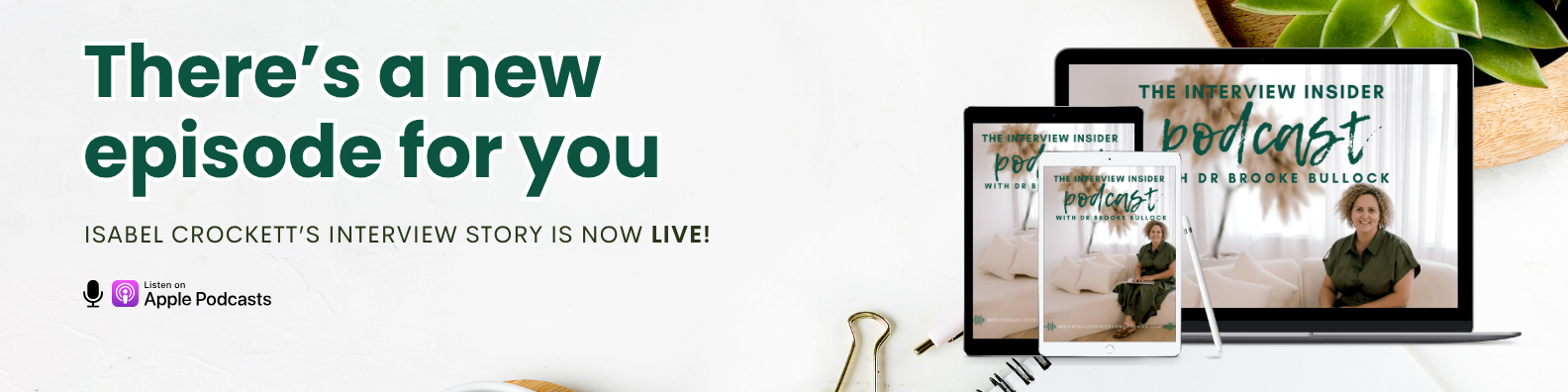
If you're preparing for a medical school interview, or know someone who is, have a listen to my chat with Isabel Crockett on The Interview Insider. Isabel sat three medical school interviews before she got in, and she talks through all of them. Pop it on when you're driving or heading out for a walk!
If you'd rather work through all of this at your own pace, the Interview Prep Masterclass takes you through how to approach different questions and how to use your own experiences to show what you have to offer, so you walk in prepared and still sounding like you.
There's a Masterclass for doctors, for surgical candidates, for nursing and allied health, and for medical school applicants.
And if you'd like some one-on-one help, feel free to have a look at the coaching options too.
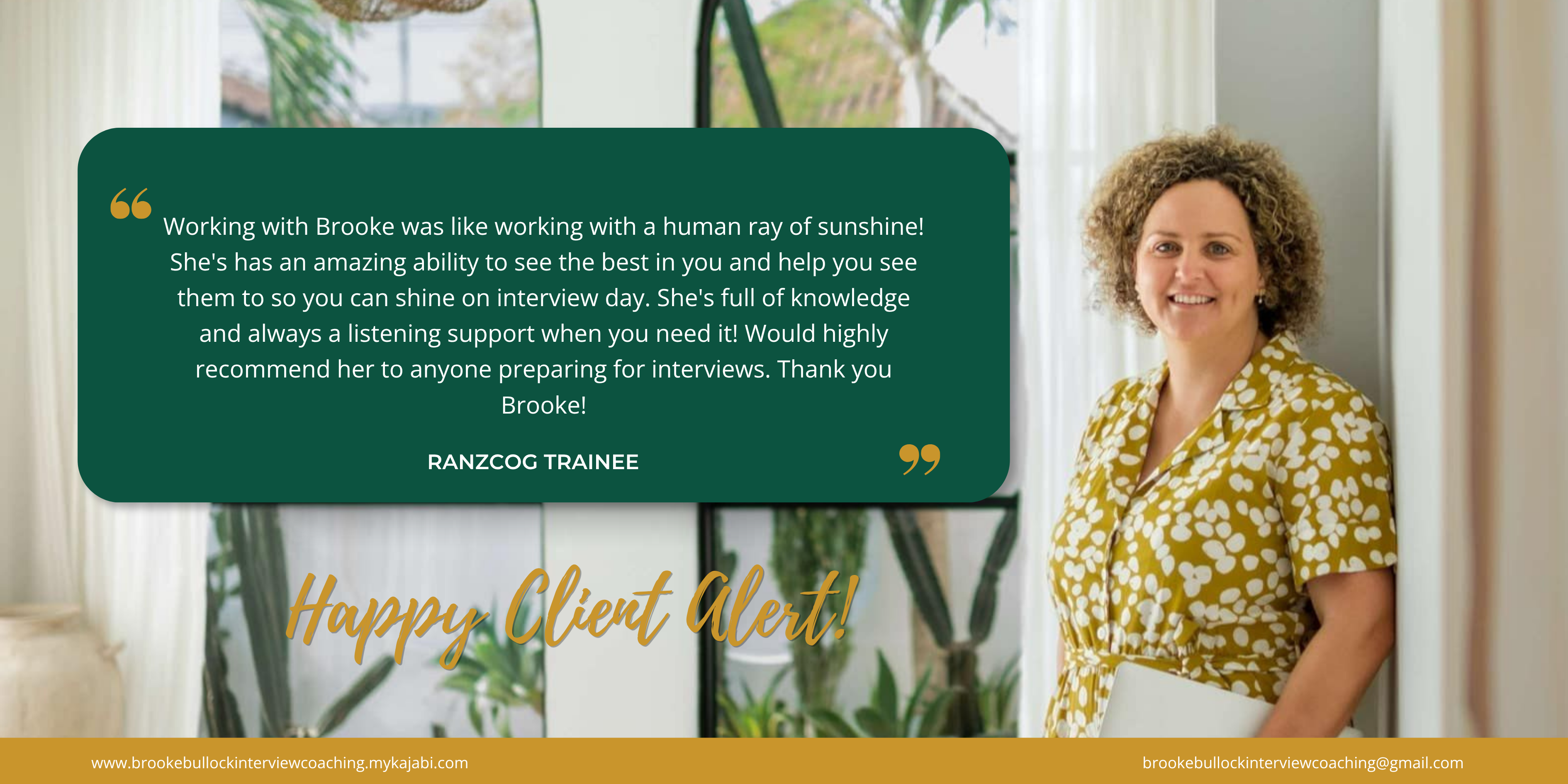
See what our clients are saying...
Doctors applying for specialty training programs: I have just the offering for you!
The 2027 Accelerator dates are locked in.
Six specialty group coaching programs run between March and August next year:
Orthopaedics, Surgical, Obstetrics and Gynaecology, Radiology, Anaesthetics and Dermatology.
Each one is five weeks long, held after hours, and finishes about two weeks before that specialty’s interview. You get weekly group coaching, a one-on-one session with me, a full mock interview with targeted feedback, the Masterclass, and a closed community for the whole five weeks.
Every session is recorded, so a week you can't make because of your roster isn't a problem.
I cap every cohort at 14, and at four per state, because I am not going to fill a room with people competing for the same handful of positions.
Enrolment is not open yet, but the expression of interest list is. I review registrations as they come in, so there is no cutoff date to beat.
Applying for a different specialty? No worries, I've got you covered. Check out the website offerings and/or get in touch!
See the full 2027 group coaching calendar and register your interest
If you're feeling a bit stuck with your answers, choosing your cards or working out what the panel really wants to hear, I'd love to help.

And if one of your five examples is giving you grief, hit reply and tell me which one.
Cheers,
Brooke
Responses